
What impact does supplemental feeding have on scientific outcomes?
In 1974, an influential paper was revealed decrying “physician-induced malnutrition” as “the skeleton within the hospital closet.” Many sufferers in hospitals had been malnourished, which the editorial board of the Journal of the American Medical Affiliation described as “surprising.” Even a single case is one too many, but to this present day the problem persists. If something, individuals with severe sickness would appear to want much more diet, not much less, but underfeeding stays widespread, involving as many as 50% of hospitalized sufferers. “The moral precept of justice” requires that each one sufferers be fed sufficient, provided that hospital malnutrition has been related to elevated threat of illness and dying. However is it trigger and impact? Does consuming much less make you sicker, or does being sicker simply make you eat much less? You don’t know till you place it to the check. However wouldn’t it be moral to randomize sufferers to stay starved? Wouldn’t dietary assist clearly assist? It seems, no. Not one however 22 randomized managed trials involving hundreds of malnourished sufferers discovered that, positive, you possibly can plump them up; nevertheless, there appears to be little impact on scientific outcomes. In truth, generally it might probably truly make issues worse. Perhaps the physique is dropping its urge for food on function.
Ever since Hippocrates, fasting has been used to assist deal with acute and persistent ailments, based mostly on the statement that when individuals get sick, they ceaselessly lose their urge for food. So, possibly that’s a part of our physique’s knowledge and we shouldn’t pressure it. However that was 2,400 years in the past. What have we discovered since?
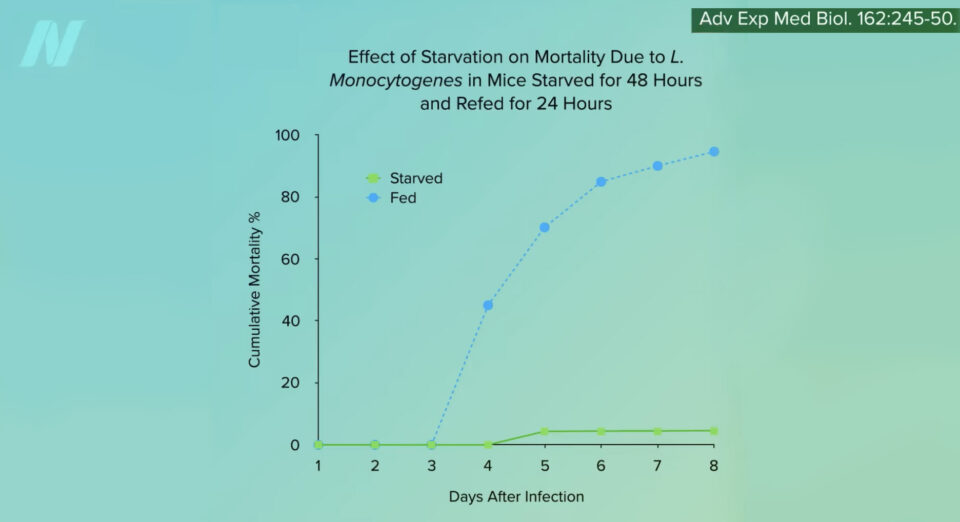
Together with fever, decreased meals consumption is certainly probably the most widespread indicators of an infection, “usually considered an undesirable manifestation of illness,” however it’s truly an energetic, useful protection mechanism. Clearly, persistent undernutrition can impair our defenses, however information counsel that within the short-term, immune perform will be enhanced by reducing meals consumption. Among the information are wild: In a single examine, after 48 hours of hunger, about 95% of mice survived an an infection in the event that they remained starved, whereas about 95% died in the event that they had been refed, as you possibly can see under and at 2:27 in my video Fasting for Most cancers: What About Cachexia?.
However that was in mice. Clearly, we will’t randomize individuals to a deadly an infection, however the examine confirmed that the blood from starved mice was practically eight instances higher at killing off the invading micro organism in a petri dish, as you possibly can see under and at 2:41 in my video.
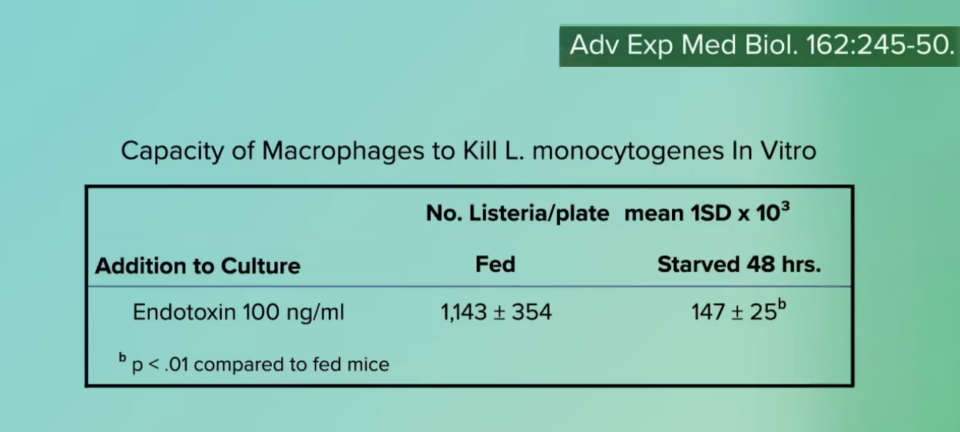
It dramatically boosted the capability of their white blood cells to kill off the pathogens. Why can’t we simply check individuals like that?
Certainly, we can. Researchers fasted individuals for 2 weeks on an 80-calorie-a-day eating regimen, and their white blood cells confirmed the identical sort of increase in bacteria-killing exercise, a lift in antibody manufacturing, and a 24% common enhance in pure killer cell exercise. That’s particularly fascinating as a result of our pure killer cells don’t simply assist clear infections; in addition they kill most cancers cells. In truth, that’s how they measured pure killer cell exercise—by pitting them towards K562 cells, that are tumor cells (human leukemia cells). So, two weeks of fasting boosted their bloodstream’s capacity to kill off most cancers cells by 24%.
So, fasting is alleged to enhance anticancer immunosurveillance—poetically described as “stimulating the urge for food of the immune system for most cancers.” So, why isn’t fasting used extra to deal with most cancers? Till lately, fasting remedy has not been thought-about a remedy choice, partly as a result of a typical therapeutic purpose in palliative most cancers care is to forestall weight reduction and counteract the losing syndrome generally known as cachexia, which is the final word reason behind dying in lots of most cancers instances.
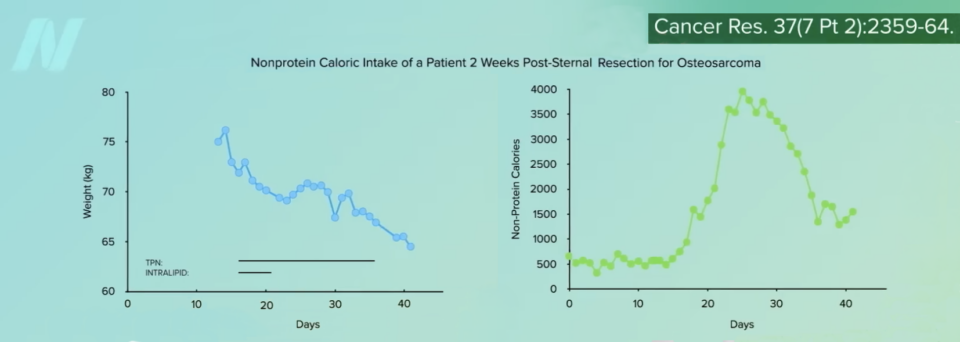
Tumors are voracious. They develop quickly, needing numerous vitality and protein, so most cancers metabolically reprograms the physique to start out breaking right down to feed them. It does this by triggering irritation all through the physique. It’s not simply that folks lose their urge for food. The important thing distinction between weight reduction from most cancers cachexia and easy hunger is that cachexia can’t be reversed by feeding alone. Take into account the case of a most cancers affected person whose weight began to drop. It’s no surprise—they had been solely taking in a couple of hundred energy a day. So, along with giving them about 100 grams of protein a day, researchers caught a tube right into a vein and infused as much as 4,000 energy a day. But it surely didn’t matter. They continued to shed weight, as you possibly can see at 4:56 in my video.
Makes an attempt to appropriate or reverse cachexia by way of therapeutic dietary interventions have had little success. The perfect remedy for most cancers cachexia, due to this fact, is to deal with the trigger and treatment the most cancers. In truth, forcing further diet on most cancers sufferers may very well be taking part in proper into the tumor’s palms. Like in being pregnant, when the fetus will get first dibs on vitamins even on the mom’s expense, the tumor could also be first within the feeding line. Perhaps the lack of urge for food that happens with most cancers is definitely a protecting response. However within the Sixties, TPN—whole parenteral diet—was born. Individuals not needed to eat; all of the diet they wanted may very well be infused straight into their veins, ushering within the fashionable period of diet assist.
TPN grew to become broadly accepted and carried out, rising right into a multibillion-dollar business. Ought to or not it’s routinely given to malnourished most cancers sufferers? The reply’s not as apparent as one would possibly assume. When it was put to the check in dozens of randomized trials, “the outcomes had been each disappointing and stunning. Parenteral diet didn’t simply fail to supply any profit to those sufferers; it induced hurt.” Not solely did it seem to present zero survival profit, however there was additionally a rise in problems and infections, and a lower in tumor response to chemotherapy, presumed to be attributable to all these further vitamins stimulating tumor development.
Equally, trials of oral dietary interventions, equivalent to giving bottles of Guarantee to malnourished sufferers with most cancers, discovered no survival benefit. Regardless of the dearth of demonstrated profit, many oncologists’ knee-jerk response to the concept of most cancers sufferers fasting is to fear that they’re not consuming sufficient already. However you don’t know till you put it to the check, which we’ll discover within the subsequent weblog.
Physician’s Observe
That is a part of an ongoing sequence about most cancers and fasting. I beforehand laid the groundwork in these two blogs: Chemotherapy is Costly—Is It Efficient? and How A lot Do New Chemotherapy Medicine Lengthen Life?.
Keep tuned for 3 extra blogs on fasting and most cancers:
What’s the fasting-mimicking eating regimen? I’ve obtained a video on that: The 5-2 Weight loss program and the Fasting-Mimicking Weight loss program Put to the Take a look at.
All of my movies on fasting will be discovered on this subject web page or within the recordings of my fasting webinar sequence.


