
An eGPU can deliver desktop-class graphics to a laptop computer, however cables, bandwidth limits and additional prices can eat into the benefit.

Connecting a desktop graphics card to your laptop computer looks like a neat answer to one of many oldest issues in transportable computing. Use the skinny machine for work and journey, and connect with a way more highly effective GPU while you get dwelling. An exterior GPU (eGPU) can do exactly that, however all that additional graphics energy nonetheless has to journey by means of Thunderbolt or USB4 as an alternative of the direct inner connection utilized by a built-in laptop computer GPU. That bandwidth bottleneck can eat into the desktop card’s benefit, and the cable it is related to holds sway as nicely.
On this comparability, “onboard” primarily refers to a devoted GPU constructed into the laptop computer, not the built-in graphics within the laptop computer’s processor. Even when a laptop computer GPU shares its title with a desktop GPU, the {hardware} might be vastly completely different. The RTX 5090 Laptop computer GPU options 10,496 CUDA cores, 24GB of GDDR7 reminiscence, and a GPU subsystem energy vary of 95W to 150W. In the meantime, you may discover 21,760 CUDA cores and 32GB of GDDR7 reminiscence on NVIDIA’s desktop RTX 5090. That is a big hole earlier than even contemplating bottlenecks, like Thunderbolt.
Thunderbolt remains to be the bottleneck
A contemporary eGPU usually communicates with the laptop computer by way of Thunderbolt or USB4, reasonably than immediately on its PCIe bus, and that is the place a few of the desktop card’s edge is misplaced. A built-in laptop computer GPU makes use of an inner PCIe connection as an alternative.
Thunderbolt 4 has 40 Gbps of general bandwidth and requires 32 Gbps of PCIe knowledge throughput, whereas Thunderbolt 5 upgrades the bottom velocity to 80 Gbps and doubles that PCIe requirement to 64 Gbps. Inside laptop computer GPUs can use wider multi-lane PCIe connections, relying on the laptop computer’s design, giving them extra room to maneuver knowledge with out the Thunderbolt bottleneck.
That bottleneck is extra noticeable with regards to a robust desktop card. NVIDIA’s desktop RTX 5090 has 1,792GB/s of reminiscence bandwidth and a 575W whole graphics energy score, in contrast with 896GB/s and a 95W to 150W GPU subsystem energy vary for the RTX 5090 Laptop computer GPU. These aren’t PCIe bandwidth figures, however they present how way more uncooked {hardware} the desktop card brings earlier than the exterior connection begins holding it again.
Thunderbolt 5 additionally has a 120 Gbps Bandwidth Increase mode, however that is not 120 Gbps of PCIe bandwidth for the GPU. Intel says PCIe knowledge throughput stays at 64 Gbps. Whereas USB4 may also help PCIe site visitors, a USB-C-shaped port alone would not assure eGPU compatibility. The host {hardware} wants the appropriate help, and the enclosure, drivers, GPU and energy necessities should all cooperate (as a result of apparently one cable was getting too simple).
Utilizing the laptop computer’s built-in show can add one other penalty as a result of rendered frames could should journey again by means of the identical restricted connection. That is why some manufacturers recommend connecting an exterior monitor on to the eGPU for higher efficiency. There isn’t any common performance-loss proportion, for the reason that GPU, laptop computer, connection, decision and recreation all have an effect on the consequence.
There is a cause the built-in GPU is slower
A laptop computer GPU begins with much less uncooked {hardware}, however it would not should take care of most of this plumbing. It operates throughout the laptop computer’s cooling and energy constraints, would not should ship rendered frames again over an exterior cable, and stays within the laptop computer while you choose it up. The portability profit is extra like a suggestion with a standard desktop-card eGPU. You now have an enclosure, a desktop GPU, and perhaps an ATX energy provide on the desk, whereas a giant card can add measurement and noise to the combination.
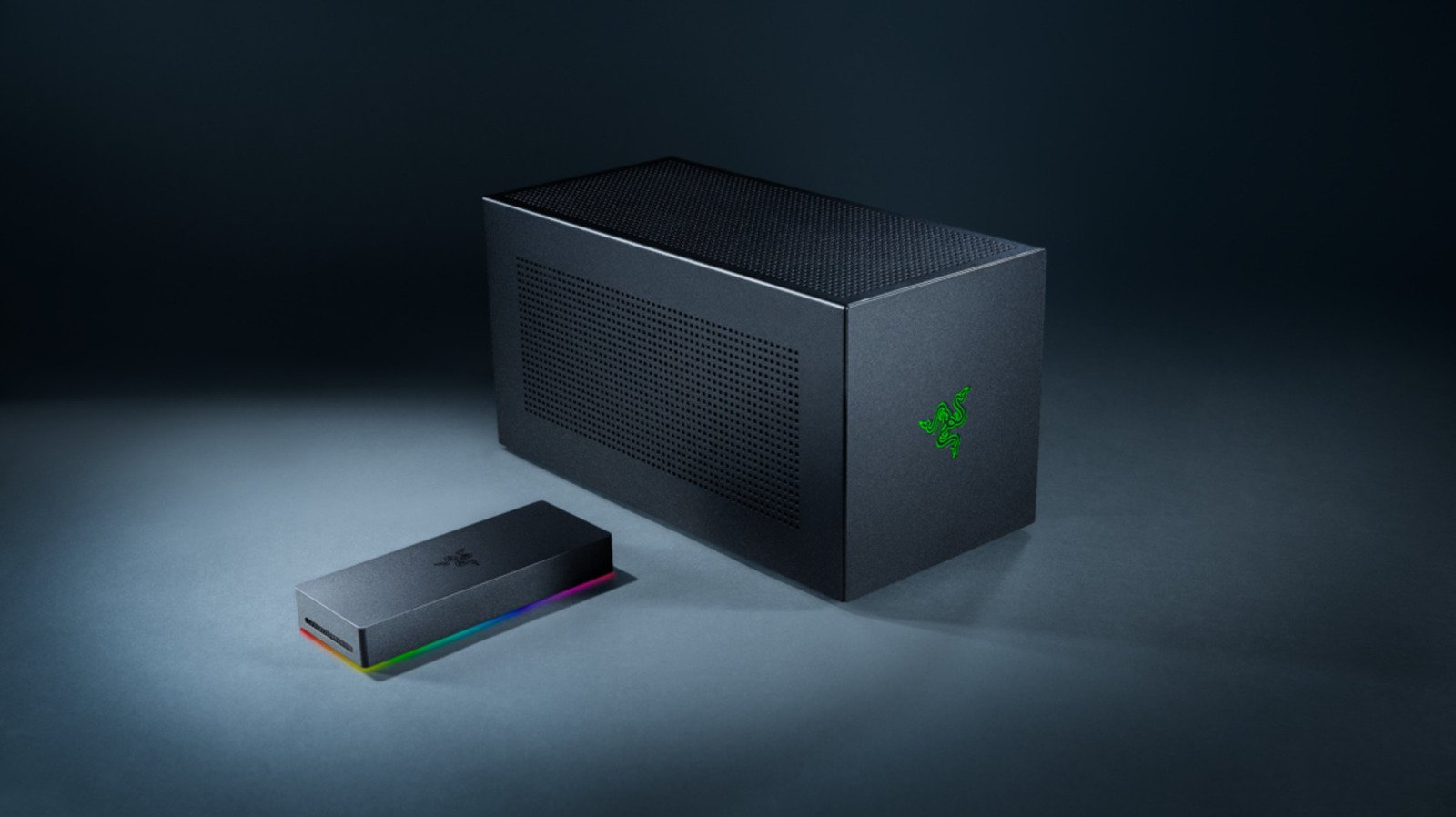
Let’s not neglect to speak about the fee related to eGPUs. For example, Razer’s Thunderbolt 5 Core X V2 helps full-size NVIDIA and AMD desktop playing cards as much as 4 slots huge. The enclosure additionally has its personal 120mm cooling fan, however it would not include a GPU and even the required ATX energy provide to maintain it operating. These could be added bills on high of roughly $350 for the enclosure itself.
That math will get significantly friendlier when you’ve got an acceptable GPU sitting round after a desktop improve. At that time, the enclosure may considerably improve your laptop computer with out shopping for one other laptop. It is harder to justify buying a high-end desktop card particularly for an eGPU, particularly because you’re paying for all that energy after which sending it by means of a cable that may not assist you to use all of it.


