
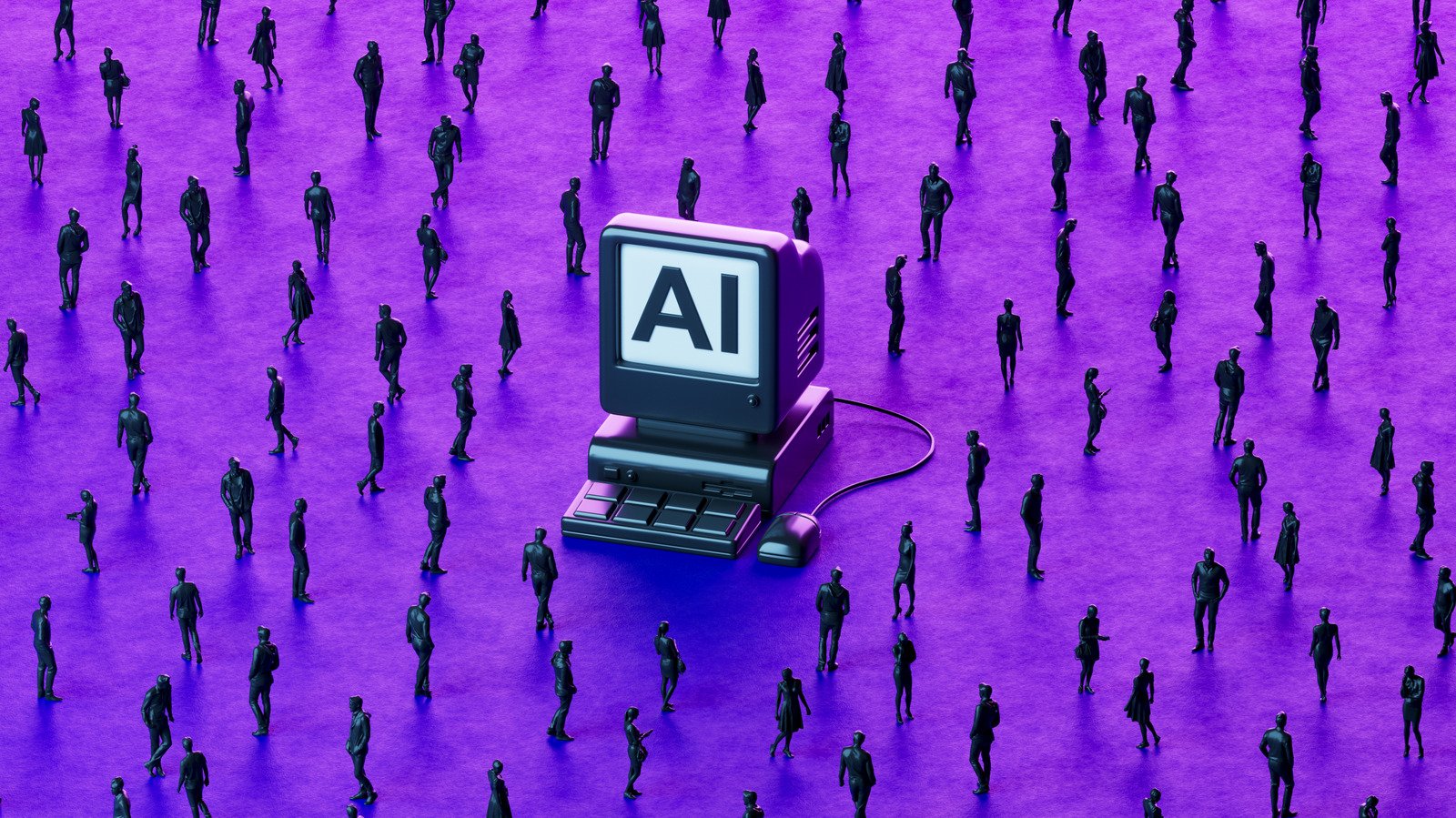
When spending time on-line at this time, do you ever get the sensation that digital life has turn into eerily much less human? Maybe social media posts appear a bit off, otherwise you get the sneaking suspicion the customer support consultant you’re chatting with is definitely a bot. If this sounds acquainted, you are not alone: a paradigm known as the “lifeless web principle” has been gaining momentum within the final a number of years, positing that the web is more and more dominated by non-human exercise, together with bots and AI-generated content material.
For the reason that principle first began making the rounds on web boards within the 2010s, AI has solely gotten extra highly effective. In September 2026, OpenAI reported that it had discovered an answer to a famously troublesome arithmetic puzzle, the Navier-Stokes drawback. In the meantime, a 2026 report from cybersecurity group Thales discovered that automated site visitors continues to overhaul human exercise on-line, with bots accounting for 53 p.c of all net site visitors, up from 51 p.c the yr earlier than. And bots at the moment are speaking to one another with out people within the loop in any respect: In March, Meta acquired Moltbook — a social community on which AI chatbots talk with each other, usually discussing people. In order the web panorama doubtlessly will get much less human day-after-day, what precisely is lifeless web principle, the place does it come from, and will we be nervous?
What’s the lifeless web principle?
Lifeless Web Concept — the concept nearly all of the web is propelled by bots and different non-human brokers – has been floating round for fairly a while. It first emerged as a conspiracy principle on web boards within the late 2010s, however gained a extra concrete framework following a put up in 2021 on on-line group Agora Street titled, “Lifeless Web Concept: A lot of the Web Is Pretend,” which argued “the Web feels empty and devoid of individuals.” Followers of the idea argued that the web “died” round 2016 when search engines like google and social media feeds began surfacing extra AI-generated content material.
The recognition of chatbots and AI-generated content material has solely additional expanded since then. In 2024, solely 33 p.c of People stated that they had used chatbots like ChatGPT, Gemini or Copilot, a research from Pew Analysis discovered. By 2026, that quantity had elevated to just about half of People at 49 p.c. That very same report discovered that 25 p.c of People use chatbots day-after-day. In lots of realms of society we at the moment are going through chatbot loops: in faculties, college students are writing essays utilizing AI, which lecturers then grade with AI. Within the job search, staff use chatbots to spit out optimized resumes and canopy letters that are then analyzed by AI techniques. More and more, people are lower out of the dialog fully, our voices changed with bots.
Ought to we be nervous?
On a private degree, this chatbot loop can really feel uncanny. These script-like posts we see on LinkedIn or a soulless AI-generated poster at your native cafe can induce a sense of existential dread, however the penalties transcend private discomfort. Bots can unfold disinformation that causes actual hurt. AI chatbots are more and more a supply of election disinformation, and little is being accomplished legislatively to manage this new frontier, although authorities businesses have issued warnings on deepfakes and different AI-powered dangers to free elections.
As AI use grows, so has the backlash: 40 p.c of People say they suppose AI can have a unfavourable influence on society within the subsequent 20 years, in keeping with a Pew Analysis research. AI detection is turning into more and more well-liked, with firm Pangram receiving $9 million in backing in July 2026 for its AI detection system. Following the passage of the EU AI Act, OpenAI has began watermarking AI-generated content material. With measures like these, individuals against AI will hopefully be capable to extra simply spot and keep away from the synthetic slop in favor of the human-centric connection they initially got here to the web to seek out.


