
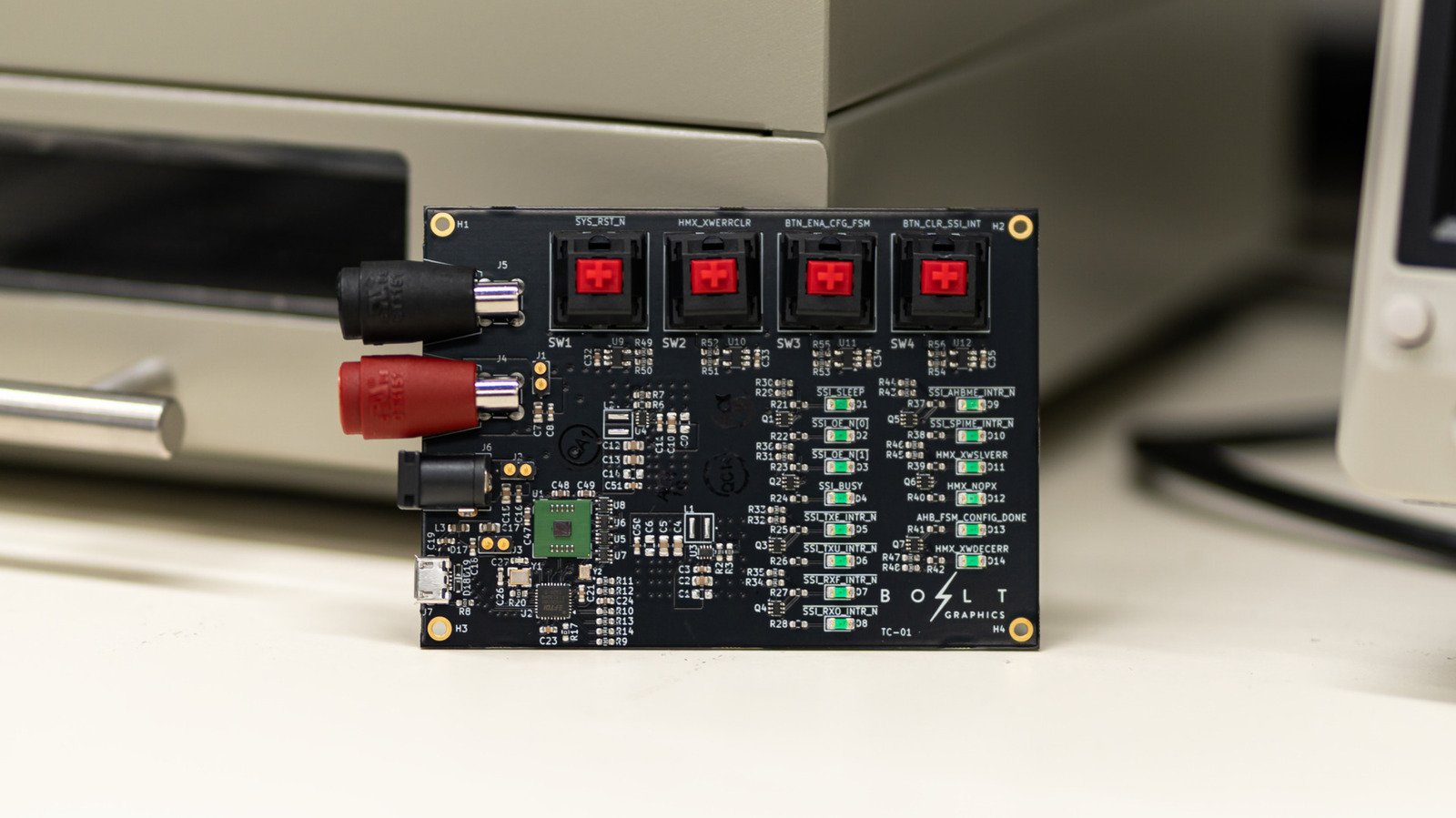
The take a look at chip ran high quality however Bolt’s Zeus GPU remains to be a great distance from transport.
Bolt Graphics has powered on the primary silicon for its Zeus GPU mission, although the cardboard it is constructing towards is not anticipated to succeed in quantity manufacturing till 2028. The California-based startup stated in mid-October that its 12nm take a look at chip, made by chipmaking big TSMC, ran with out points when switched on. Bolt additionally stated it had opened an workplace in Taipei to remain near its manufacturing companions forward of manufacturing. Two days later, Reuters reported that Bolt was making an attempt to boost about $100 million at a valuation of round $700 million, citing three folks acquainted with the matter.
The take a look at chip measures 6mm^2 and attracts 1.4 watts, in contrast with the 35 watts utilized by the FPGA (a reprogrammable chip used for prototyping) that Bolt beforehand ran its design on. Its predominant characteristic is devoted {hardware} for electromagnetic simulation, which helps design every little thing from radar sensors to digicam lenses.
Bolt’s CEO and founder Darwesh Singh instructed HPCwire that the chip reveals Bolt can run “a extremely complicated physics algorithm, accelerated in {hardware}, which nobody’s completed earlier than.” Nevertheless, Bolt hasn’t printed any efficiency figures for the take a look at chip, saying solely that it beat the corporate’s inside estimates. The Zeus GPU Bolt plans to debut is a totally separate chip that’ll be made on TSMC’s N5P course of node. Bolt says it picked the 2020-era N5P course of to keep away from competing with different chipmakers for already restricted wafer provides.
What’s Zeus, precisely?
Bolt’s Zeus GPU is constructed round RISC-V processor cores, which use an open-standard instruction set, paired with Bolt’s personal path-tracing {hardware}. Its PCIe playing cards will mix soldered LPDDR5X reminiscence with the DDR5 SO-DIMM slots you may often discover in a laptop computer, letting house owners increase the playing cards as much as 384GB of reminiscence. When Bolt introduced Zeus in March 2025, it made lofty claims of 10 occasions the rendering efficiency of present GPUs and 300 occasions the velocity in electromagnetic simulation, saying Zeus may ship as much as 10 occasions the trail tracing throughput (i.e., what number of mild rays a rendering system can course of per second) of Nvidia’s RTX 5090.
As is often the case in conditions like this, these claims haven’t been independently examined. Bolt is promoting Zeus to studios, engineers and scientists first, with plans to increase into gaming and AI later. That’d put Zeus within the shopper GPU market in opposition to Nvidia and AMD. That shall be an fascinating transfer, given, as Reuters identified, the deep software program help a gaming chip must run the 1000’s of video games already on sale.
Bolt stated again in April that greater than 14,000 companies, devs and particular person customers had signed up for its early entry program, and that it had a product pipeline value greater than $500 million. It didn’t, nonetheless, identify any prospects. In the identical announcement, Bolt additionally claimed that Zeus would reduce compute prices by as much as 17 occasions in contrast with present {hardware}.


